Credit: Pensoft Publishers
CO-OP4CBD partners co-author new report on the launch of the European Subregional TSCC
The European Subregional Technical and Scientific Cooperation Support Centre (TSCC) was officially launched in September 2025. This new subregional entity under the Convention on Biological Diversity (UN CBD) is meant to fulfil a crucial role in the effective implementation of the Kunming-Montreal Global Biodiversity Framework (KM-GBF). For that purpose, the European TSCC will be organised into distinct Knowledge Hubs, each aligned with one of the 23 targets underpinning the KM-GBF in support of science-policy dialogue in 44 countries.
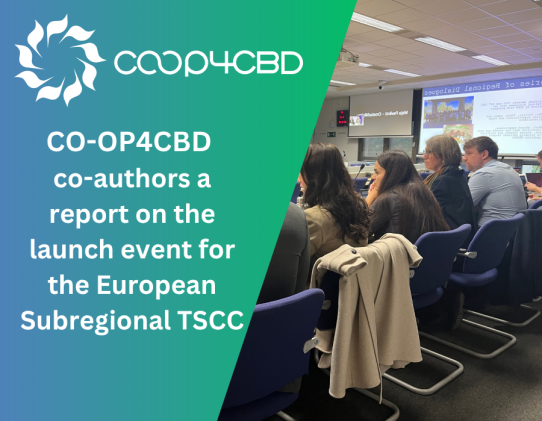
After many months of preparation, a dedicated two-day launch event marked the official presentation of the Centre, an occasion which brought together nearly 100 participants representing 36 institutions and 18 nationalities. The European Commission’s Joint Research Centre (EC JRC), through the Knowledge Centre for Biodiversity (KCBD) served as the organiser along with the other partnering organisations representing the driving force behind the TSCC - the IUCN Centre for Mediterranean Cooperation (IUCN-Med), the European Environment Agency (EEA) and the Royal Belgian Institute of Natural Sciences (RBINS). CO-OP4CBD supported the coordination of proceedings, with consortium members Camille Guibal and Constance Laureau (French Foundation for Research on Biodiversity), joined by the EC JRC’s Giacomo Montereale Gavazzi, also subsequently assisting in the publication of an overview report on the launch.
The event was an opportunity for participants, namely from EU Member States and associated countries, to reflect on challenges and needs both for the 7th National Reports and from the TSCC itself later on. The newly released reports thus provides context on the structure, governance and operating model of the TSCC as well as the existing Knowledge Hubs as they relate to their respective KM-GBF targets. The discussions at the launch outlined within revealed that UN CBD Parties face “cooperation and coordination challenges” when it comes to securing up-to-date biodiversity knowledge and expertise of the kind the TSCC is to provide.
Also in focus within the document were participants’ expressed needs during breakout sessions on the provision of a “matchmaking service” linking experts to the Knowledge Hubs’ activities. Moreover, those in attendance were asked to rank the KM-GBF targets according to their respective national priorities as part of this process. The conversations coalesced into several concrete recommendations for the future – examples include an equitable governance model for the Knowledge Hubs, a helpdesk facilitating a potential matchmaking framework as well as forums for engagement with fellow experts and receiving updates in relation to the TSCCs in general.
You can access the full document here. More information on CO-OP4CBD's contribution to the launch event can be found in this article.