Credit: Pensoft Publishers
Málaga hosts CO-OP4CBD training and networking session on the Clearing-House Mechanism and Technical and Scientific Cooperation in the context of the UN CBD
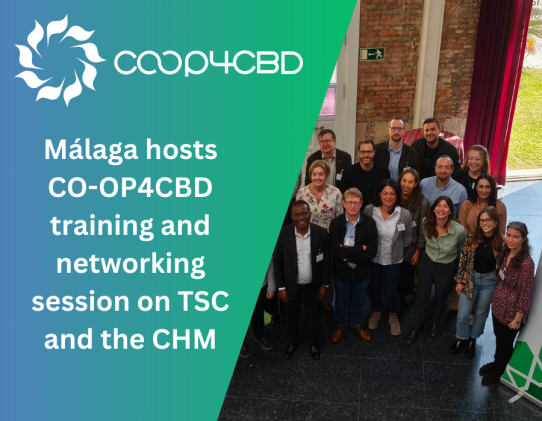
The latest training event to be organised by the CO-OP4CBD project was held between 18 and 20 November in the Spanish city of Málaga. For this edition, the agenda zeroed in on two crucial processes within the framework of the UN CBD – Technical and Scientific Cooperation (TSC) and the Clearing-House Mechanism (CHM). Researchers and stakeholders involved in the European biodiversity landscape joined this hybrid event both on site and online for an introduction to the underlying intricacies behind these topics. Moreover, the interactive programme allowed them to make concrete inquiries, share personal opinions and exchange unique perspectives in a direct dialogue with established experts in this context.
Jointly organised by consortium partners from the French Museum of Natural History (MNHN) and the Royal Belgian Institute of Natural Sciences (RBINS), the event was hosted by the International University of Andalucía (UNIA) with support from IUCN Med. On the side of session speakers and participants, representatives from an array of institutions were represented, including:
-
the Global Biodiversity Information Facility (GBIF)
-
the Foundation for Research on Biodiversity (FRB)
-
the UN Food and Agriculture Organisation (FAO)
-
the Group on Earth Observations Biodiversity Observation Network (GEO BON)
-
the Ministry of Environment and Physical Planning of North Macedonia
-
the Ministry of Agriculture, Fisheries, Food Security and Nature of the Netherlands
-
the European Commission’s Knowledge Centre for Biodiversity (KCBD)
-
the European Commission’s Joint Research Centre (JRC)
-
the European Environment Agency (EEA)
More specifically, the three-day programme featured several distinct sessions convening various expert panels and covering the following subjects of interest:
-
the monitoring framework of the KM GBF and the associated reporting challenges
-
introduction to and exchange of experiences around the 7th UN CBD National Reports
-
detailed guidance on navigating the latest iterations of the TSC and CHM paradigms
-
the Bioland tool and its importance to the wider CHM network landscape
-
the role of the European Subregional TSC Support Centre (TSCC) and its Knowledge Hubs approach covering each of the KM GBF targets.
The final afternoon of the event also saw a group exercise on engaging with Knowledge Hubs for biodiversity that will structure the actions of the European Subregional TSCC. This format provided an opportunity for practical, hands-on experience in harnessing the attendees’ improved understanding of TSCC structures and procedures.
Following three days of insightful showcases and active discussions, participants attested to the importance of training and networking events of the kind held in Málaga and organised by CO-OP4CBD in general. In their view, those provide an occasion not only for crucial capacity-building among biodiversity specialists, but also for establishing and strengthening lines of communication across institutions, borders and disciplines at the science-policy interface.
All materials from the event will be made available on the CO-OP4CBD Training Corner in the coming weeks.